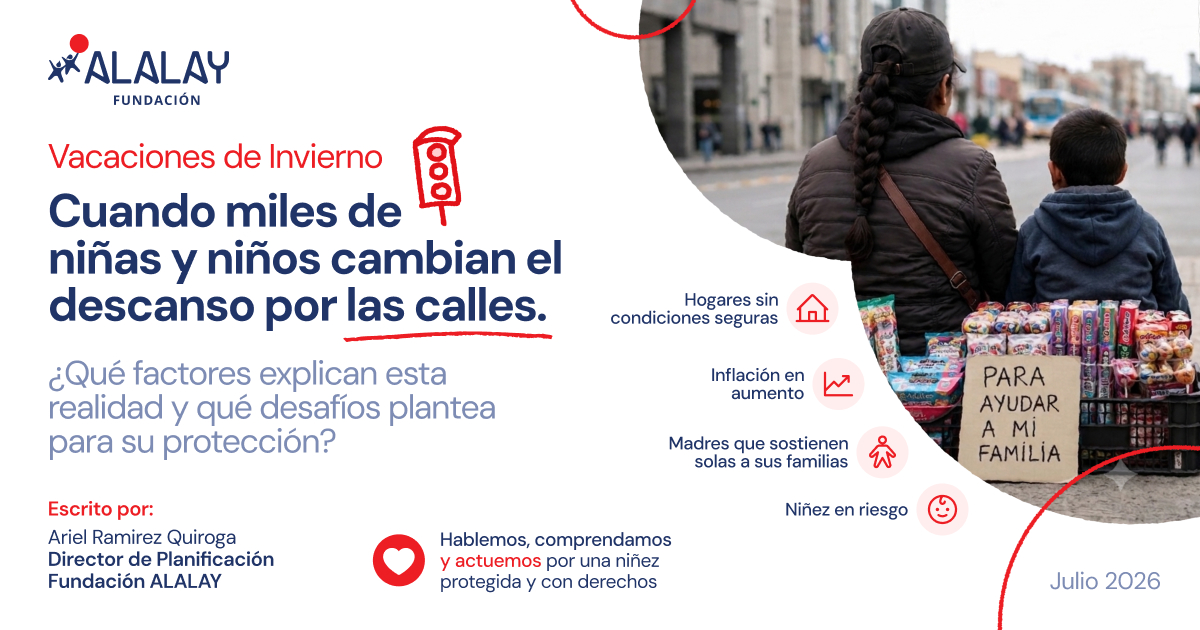
Winter Break: When Thousands of Children Trade Their Time Off for the Streets
For most children and adolescents, winter break is a time for rest, recreation, and strengthening family bonds. However, for thousands of Bolivian children, this period means something very different: temporarily leaving school to join their families in informal economic activities, mainly on the streets, in markets, at fairs, at bus terminals, and even in hazardous areas such as the mines.
Over the past few weeks, intervention teams from the ALALAY Foundation have observed a significant increase in the number of children and adolescents accompanying their mothers in informal trade activities, such as street vending and the sale of food, candy, beverages, fruit, used clothing, and other products. Although these children often do not directly handle the sales, they spend long hours in public spaces exposed to multiple physical, psychological, and social risks, sometimes remaining on the streets for more than 12 hours a day alongside their families in order to earn as much money as possible.
This phenomenon cannot be analyzed solely from the perspective of child labor, since it does not involve direct remuneration; rather, it must be understood within the complex economic context currently facing Bolivia, characterized by a sustained increase in the cost of living, a loss of household purchasing power, the growth of the informal sector, and rising social vulnerability. A recent study by Fundación Jubileo points out precisely that Bolivia is facing an economic crisis, cumulative inflation, high levels of informality, and stagnant production—factors that are deteriorating the living conditions of thousands of Bolivian families. Add to this situation 50 days of roadblocks, primarily in the western part of the country, which caused the price of the basic food basket to rise by up to 150%, a situation that severely affected the upper and middle classes—which, based on this analysis alone, illustrates the terrible impact on these highly vulnerable families.
Inflation Hits Poorest Families First
Inflation does not affect all households equally. While a family with stable income can partially absorb price increases, households that survive on informal commerce experience an immediate reduction in their ability to buy food, medicine, transportation, and basic services. In Bolivia, over recent months, the price hikes in essential foods—such as meat, oil, rice, sugar, vegetables, hygiene products, and transportation—have forced thousands of families to increase their working hours just to maintain an income similar to what they earned before. If they previously spent 8 hours on the streets, they must now spend more than 12 hours.
For those living off informal commerce, there is no fixed salary, paid vacation, health insurance, or job stability. Every day without a sale represents a day without income. As they often mention, they cannot afford to get sick or miss a single day, regardless of extreme weather conditions like severe cold (in the western highlands) or extreme heat (in the eastern lowlands). Therefore, during school vacations, many mothers take advantage of the fact that their children are not attending classes to bring them along to their workplaces. This is not out of a desire to involve them in labor activities, but because they have no other alternative to simultaneously guarantee their children’s care and generate family income.
Poverty Has a Child and Female Face
A study prepared by the Jubileo Foundation shows that poverty in Bolivia has a clearly identifiable profile: it mainly affects women, young populations, indigenous people, and informal workers, revealing that children constitute the most vulnerable age group. According to this analysis, nearly 50% of children under 12 live in poverty, a percentage higher than that observed in the adult population. Similarly, women present higher levels of poverty than men due to labor gaps, the burden of domestic work, and difficulties in accessing formal employment.
This reality is clearly reflected on the streets.
During the field sweeps conducted by the ALALAY Foundation, the vast majority of adults carrying out economic activities are women accompanied by girls and boys. This situation is no coincidence; many of them are single mothers, separated, or abandoned by their partners, who fully assume the economic responsibility and care of their children. Technically, we call these single-parent families, a situation reflected when a mother faces the survival of the entire household alone. One of the aspects causing the greatest concern during ALALAY’s fieldwork is the growth of female-headed single-parent families.
When ALALAY’s street teams ask mothers why their children spend so many hours on the streets, the response is usually repeated with little variation:
“I have no one to leave them with.” “I live alone with my children.” “If I don’t work, we don’t eat.” “I’m afraid something will happen to them at home.”
These responses help us understand that the presence of children and adolescents in public spaces does not always stem from an economic decision geared toward child labor, but rather from a care strategy developed by mothers facing extreme levels of precariousness, which I explain below.
Many Families Live in Rented, Single-Room Spaces
That single room functions simultaneously as a bedroom, kitchen, dining room, and living space. There are no safe areas for children to remain alone for ten or twelve hours. Mothers express constant fear of domestic accidents, fires caused by improvised stoves, gas leaks, electrocutions, or situations of violence and sexual abuse.
In numerous cases, these housing units are located within tenement houses (inquilinatos) where multiple families coexist without adequate security conditions. Alternatively, some families act as caretakers—meaning that as a form of rent payment, they offer to watch over a house, but the owners similarly offer them only a single room.
From the perspective of these mothers, bringing their children with them represents the protective mechanism they consider least risky. Paradoxically, this strategy exposes them to other equally serious dangers, as well as a lack of understanding from some citizens who think the mothers are using the children, when their reality is entirely different.
The Streets are Also High-Risk Spaces
Although many families believe keeping their children close provides them with protection, the streets constitute highly dangerous environments for child development. Children remain exposed for hours to the freezing temperatures typical of winter, environmental pollution, traffic accidents, urban violence, economic exploitation, alcohol and drug consumption, crime, human trafficking, commercial sexual exploitation, and multiple forms of abuse.
In Bolivia, there is a very particular dynamic because these informal economic spaces also house businesses that benefit from high pedestrian foot traffic—such as bars, brothels, and cheap lodging houses—all sharing the exact same territorial space. Without looking any further, we can just think of La Ceja in El Alto, El Mercado de La Cancha in Cochabamba, or La Ramada in Santa Cruz.
School Vacations Prolong Time Spent in These Spaces
While during the school year many children accompany their mothers for only a few hours after classes, during the winter break they remain for practically the entire work day, which—as mentioned—can reach more than 12 hours. This prolonged exposure affects not only their physical health but also their emotional well-being, learning processes, and psychosocial development.
Informality as a Cycle of Poverty Reproduction
The study by the Jubileo Foundation demonstrates that one of the factors that best explains the persistence of poverty in Bolivia is high labor informality. While only 12.1% of those with formal employment find themselves in poverty, around 40% of people working in the informal economy remain poor. This means that working no longer guarantees overcoming poverty when that employment lacks stability, social protection, and sufficient wages.
This data is especially relevant for understanding the increase of children on the streets during vacations. The majority of mothers observed by ALALAY develop completely informal commercial activities with product capital between 100 and 200 bolivianos, achieving a daily profit of about 50 bolivianos in the best-case scenario. This money has currently lost 40% of its value; meaning that if this family could previously buy a kilo of meat with that profit, today it is only enough to buy half a kilo—all due to the inflation existing in Bolivia. Not to mention those days of road blockades, when products practically didn’t exist, and if they did, their cost skyrocketed by 100%.
If a mother stops working to care for her children during a two-week vacation, the household loses a significant portion of the resources destined for food, rent, or transport. Faced with this situation, many choose to incorporate their children into their work routines, not because they want to violate their rights, but because the economic system does not offer accessible childcare alternatives.
More Urban Poverty, Greater Presence of Youth on the Streets
Another relevant aspect we have detected at ALALAY is that the majority of poor people in Bolivia currently live in urban areas. Although proportionally poverty remains higher in rural zones, in absolute terms, nearly 59% of poor people reside in cities, where labor informality, high cost of living, and precarious housing predominate. It is precisely these urban spaces where ALALAY carries out its daily interventions.
Every winter, the streets of La Paz, El Alto, Santa Cruz, and other cities show a visible increase in children accompanying family economic activities. This phenomenon constitutes an indirect indicator of the deterioration of urban economic conditions.
It is important to recognize that many children observed during vacations do not yet participate directly in productive activities:
Initially, they simply accompany their mothers.
Later, they help arrange merchandise.
If they are older, they split up sales points or routes alongside their mother.
Obviously, this gradual process constitutes an entry point to permanent street work and school dropout. If public prevention policies do not exist, many children end up normalizing long workdays from an early age.
Finally, We Must Remember
The increase of children on the streets during school vacations constitutes much more than a seasonal phenomenon; it is clearly the visible reflection of an economic crisis that is hitting Bolivia’s most vulnerable households hardest. Inflation, the rising cost of living, the precariousness of informal employment, the expansion of single-parent families, and the absence of childcare services converge to force thousands of mothers to make extremely difficult decisions: go out to work with their children or jeopardize their safety by leaving them alone in precarious homes.
The observations made by the ALALAY Foundation show that behind every child present on the street, there is a story of family survival, not parental indifference. From the logic of their mothers or families, they are better protected next to them, though it is undeniable that they are exposed to serious risks.
Consequently, addressing this issue requires recognizing that child labor and the permanence of children on the streets during school vacations cannot be understood solely as a child protection issue. They also constitute an indicator of the deterioration of the country’s socio-economic conditions and highlight the urgent need to strengthen public policies aimed at reducing poverty, expanding social protection networks, and ensuring that no family has to choose between caring for their children or securing their daily food. We tell you this because, day after day at ALALAY, we observe and learn about stories that cut deep. As an institution, we are left to accompany these processes from the streets; we would love to have all the necessary funding to lift these families out of these situations entirely, but it is impossible unless we work jointly with the State and our friends from other NGOs.